

Market standards
Common rules, conventions, identifiers, tolerances, and operating expectations that recur across financial workflows.
Fontana’s Knowledge Graph is an agent-native knowledge engine for financial operations: one governed graph per workspace connects the standards everyone recognises with the rules, decisions, approvals, exceptions, and process flows that make each firm’s work unique, retrievable with citations on every turn.
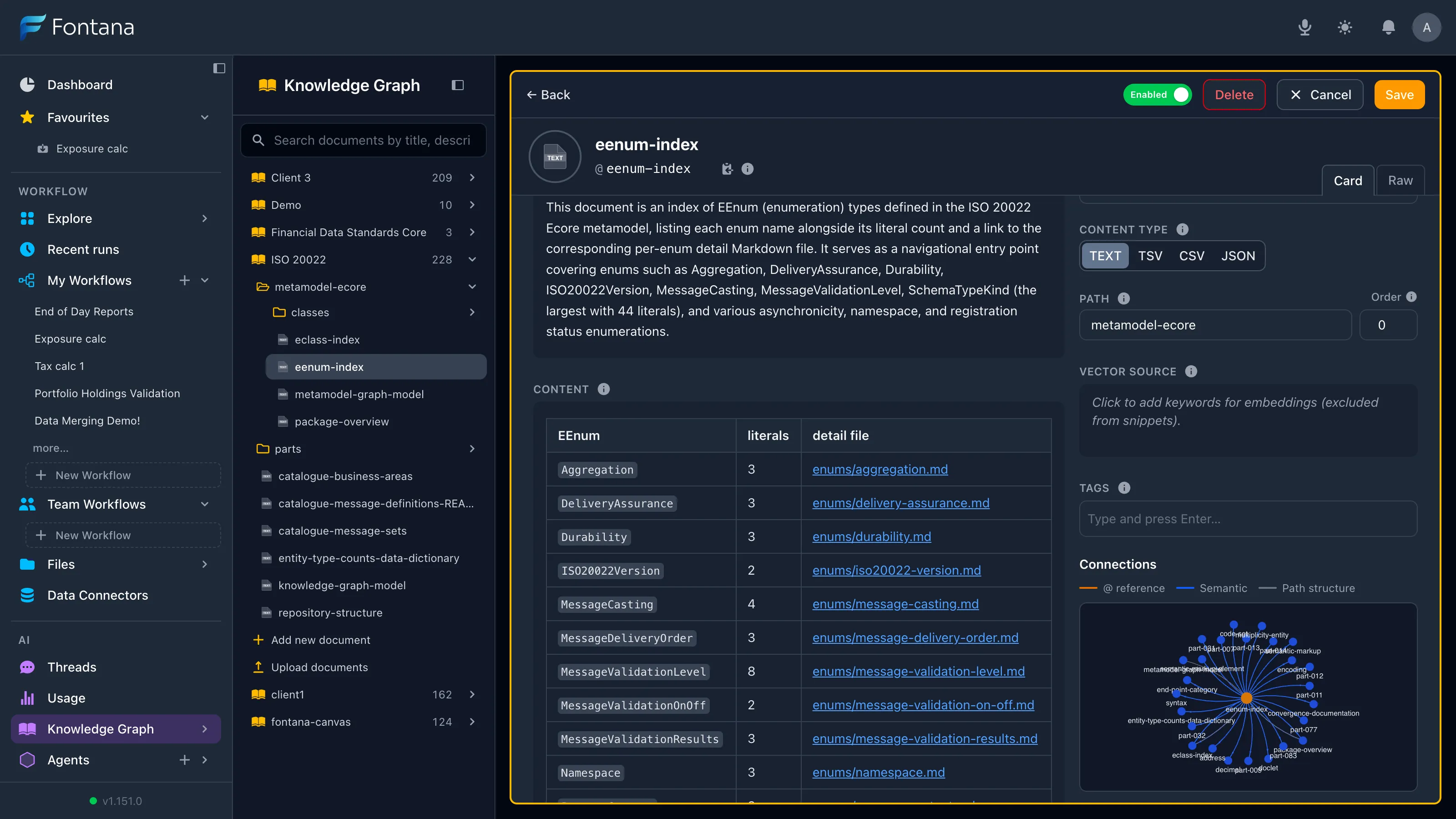
The Knowledge Graph captures how your financial operations actually work: your operating model, system architecture, process flows, business rules, approvals, exceptions, and workflow logic.
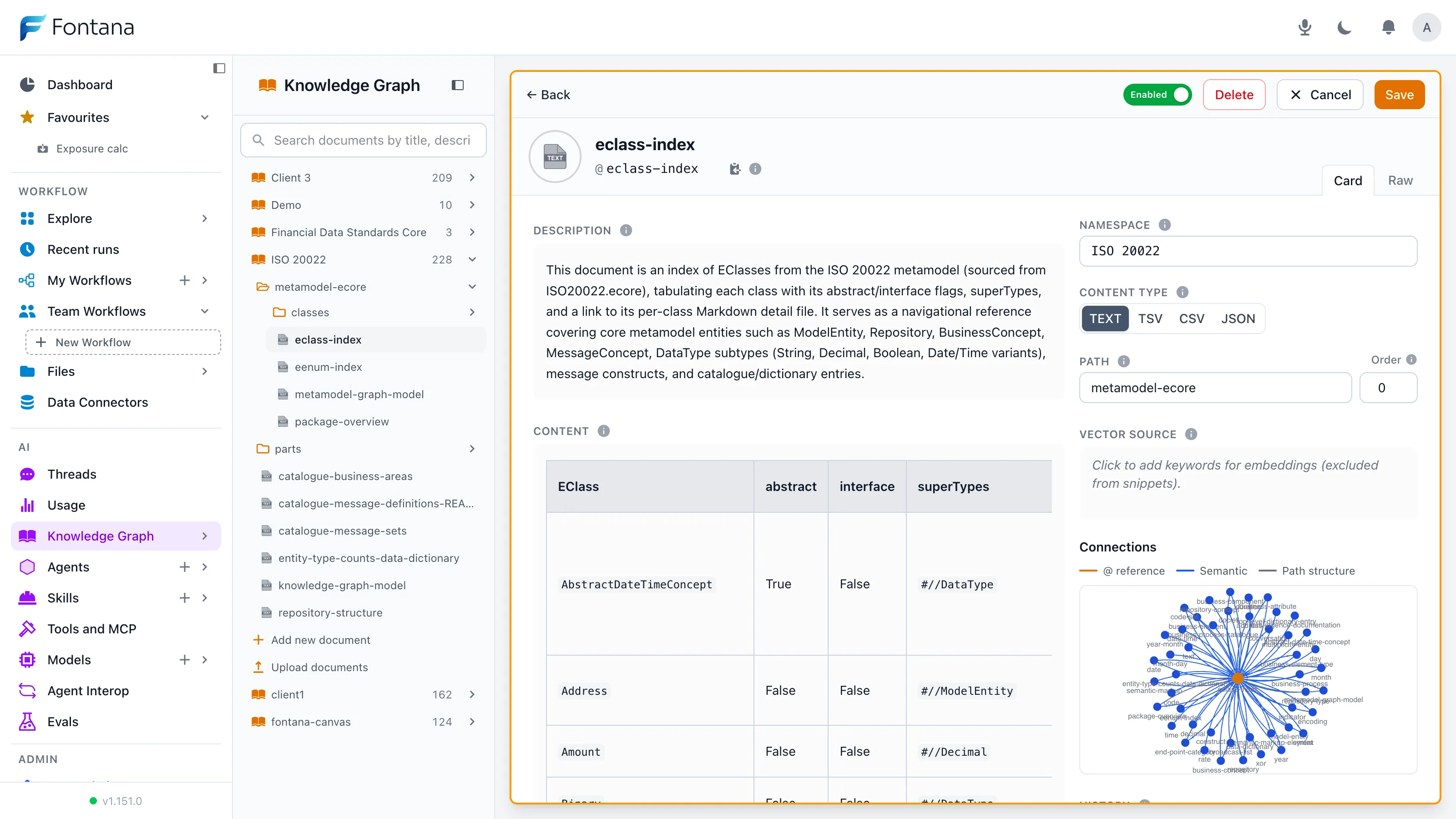
Common rules, conventions, identifiers, tolerances, and operating expectations that recur across financial workflows.
The local rules, policies, calendars, mappings, thresholds, owners, and review paths that make a workflow yours.
Resolved assumptions, approved exceptions, review outcomes, and historical choices that should not be rediscovered.
How work moves from source file to validation, exception handling, approval, output, delivery, and evidence.
Break types, root-cause patterns, routing, comments, resolution paths, and replay history.
Who approved what, when, against which version of the rule, mapping, workflow, or output.
Fontana Knowledge Graph
Fontana’s Knowledge Graph is the governed operational memory for your firm: market standards, policies, mappings, prior decisions, approvals, and exception history are collated into one operating graph so AI agents can reuse approved context for day-to-day analysis, workflow configuration, and controlled execution, not ad-hoc rediscovery.
Every namespace gets one graph, processed in independent lanes and served through hybrid search, outline navigation, and entity navigation, all reachable from Flow chat and from an MCP server for other agents.
Structure, vector, and reasoning lanes work through every uploaded file independently, so full-text and outline search go live in seconds while typed entity extraction keeps running in the background.
Lexical, structural, domain, and vector overlays sit on the same governed graph per workspace, so agents get citations back to the exact document and section instead of disconnected snippets.
Explore the domain graph, document outline, similarity map, and ontology from one workspace view, scoped to the query you are working with.
Agents reach hybrid search, outline navigation, and entity navigation through a Model Context Protocol server, with namespace access control enforced on every call.
Review processing cost and time estimates before you commit a namespace or folder to reasoning-stage extraction.
Rules, mappings, decisions, and exception patterns become reusable, helping teams and approved agents configure faster, automate more work, lower operating cost, and produce evidence as work happens.
Approved rules, mappings, checks, and workflow patterns become reusable across clients, funds, files, systems, and processes.
Reusable operating context increases the amount of work that can run through approved workflows without manual intervention.
Teams spend less time repeating analysis, rebuilding mappings, maintaining spreadsheets, and recreating the same implementation work across clients and workflows.
Decisions, approvals, versions, lineage, exceptions, and outputs are captured as the work happens, not assembled after the fact.